Working together
From working alone to a sales team
What breaks the moment you're no longer the only one, and the three agreements that catch it.
About 6 minutes to read
What breaks
As long as you sell on your own, your head is your system and it works fine. You know who you've spoken to, what you promised and who you need to ring back.
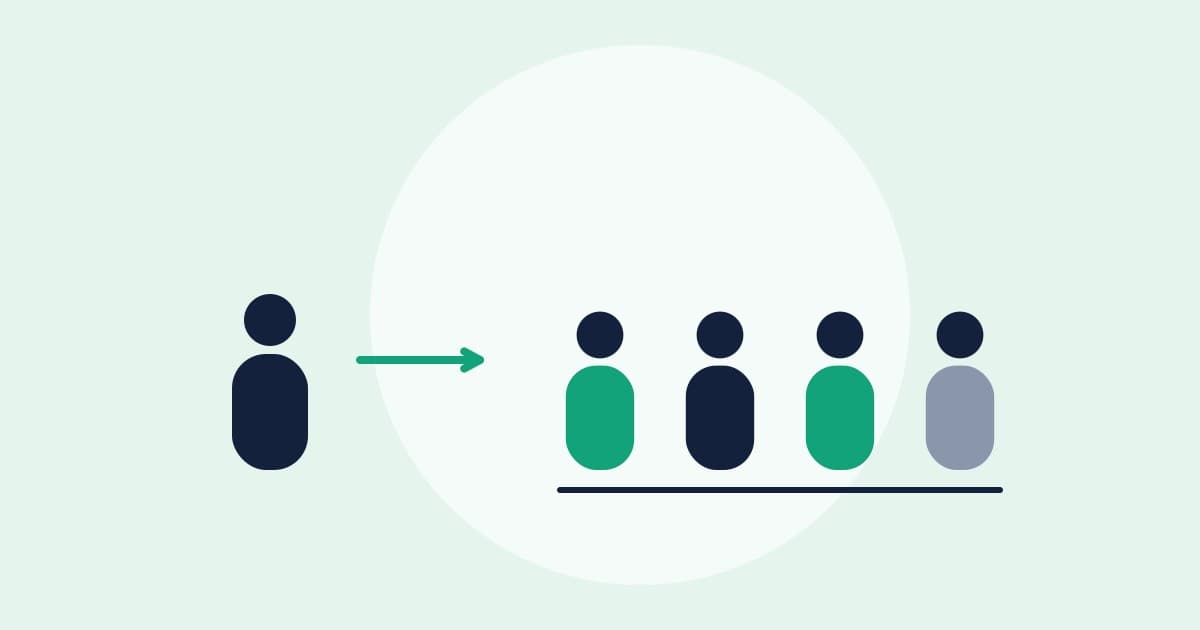
The moment a second person arrives, that breaks at one point: what you know is no longer what the business knows. That isn't a gradual decline, it's a hard line. From then on, every conversation that isn't written down is information the business doesn't have.
And it doesn't show up straight away. For the first few months you patch it with conversations and messages. It becomes visible when a customer asks something while you're on holiday.
Agreement 1: one owner per customer
Not out of hierarchy, but because a customer belonging to two people belongs to nobody. Two people each assuming the other will ring is the most common way a deal quietly disappears.
One name per company, one name per deal, one name per task. That's the whole system. Whoever takes over changes the name — see the piece on handing over a customer.
Agreement 2: three lines after every conversation
This is the agreement you could skip as a sole trader and can't any more. What they wanted, what you said, what the next step is and when.
The resistance to it is always the same: it feels like admin for the boss. And it is, as long as nobody gets anything out of it. It turns the moment someone rings a customer for the first time with a colleague's notes next to them and notices the conversation goes differently.
Let that happen rather than explaining it. More in the piece on getting your team to keep it up.
Agreement 3: one price list, and record the exceptions
As a sole trader you work out every price afresh and remember what you did. With two salespeople, two similar customers get two different prices, and that comes out eventually.
Write down your standard prices and agree who may deviate and by how much. And more importantly: record every exception against the customer, not in somebody's head. A discount that was promised once and is written nowhere is an argument you lose in two years' time.
The bit that isn't about the CRM
Taking on your first employee is its own event, and it has nothing to do with software. In the UK it means registering as an employer and setting up PAYE with HMRC, working out what the person actually costs (minimum wage, National Insurance, sick pay, pension contributions, parental leave), putting employers' liability insurance in place, and understanding your auto-enrolment pension duties.
None of that is hard, and all of it takes longer than you expect. GOV.UK sets out the steps in order, and it's worth reading them before you make the offer rather than after.
What not to do
Don't invent a twelve-step sales process straight away. The temptation is strong when you're growing, and it's too early. With a team of three, the pipeline you already had is usually good enough.
Don't start measuring on volume. How many calls, how many fields filled in — that can be inflated without anything improving, and it ruins the trust you need most at this point. The only thing you need to know in this phase is whether every live opportunity has a next step.
Don't let two systems exist. Half the team in Outlook and half in the CRM means neither is accurate. One of them has to go, even if the other was better in parts.
What you do set up
Three things, and together they cost an afternoon.
Roles. Who can do what. Give read-only away generously to everyone who needs to see but doesn't need to fill anything in — see the piece on roles and permissions.
One weekly slot. A quarter of an hour where you look together at where nothing has happened. Without blame; the aim is to stop something disappearing between two people.
A place where the agreements are written down. Three lines in a document is enough. An agreement that only exists verbally doesn't apply to whoever joins next year.
Sources
- Employing staff for the first time — GOV.UK
- Business population estimates for the UK and regions 2025 — Department for Business and Trade, GOV.UK