You are the sales and the delivery
Which means you sell in the weeks when work is thin, and not in the weeks when you're flat out. That is exactly when the chasing stops, and six weeks later the phone is quiet. Nermio is the list that carries on while you're on the job.
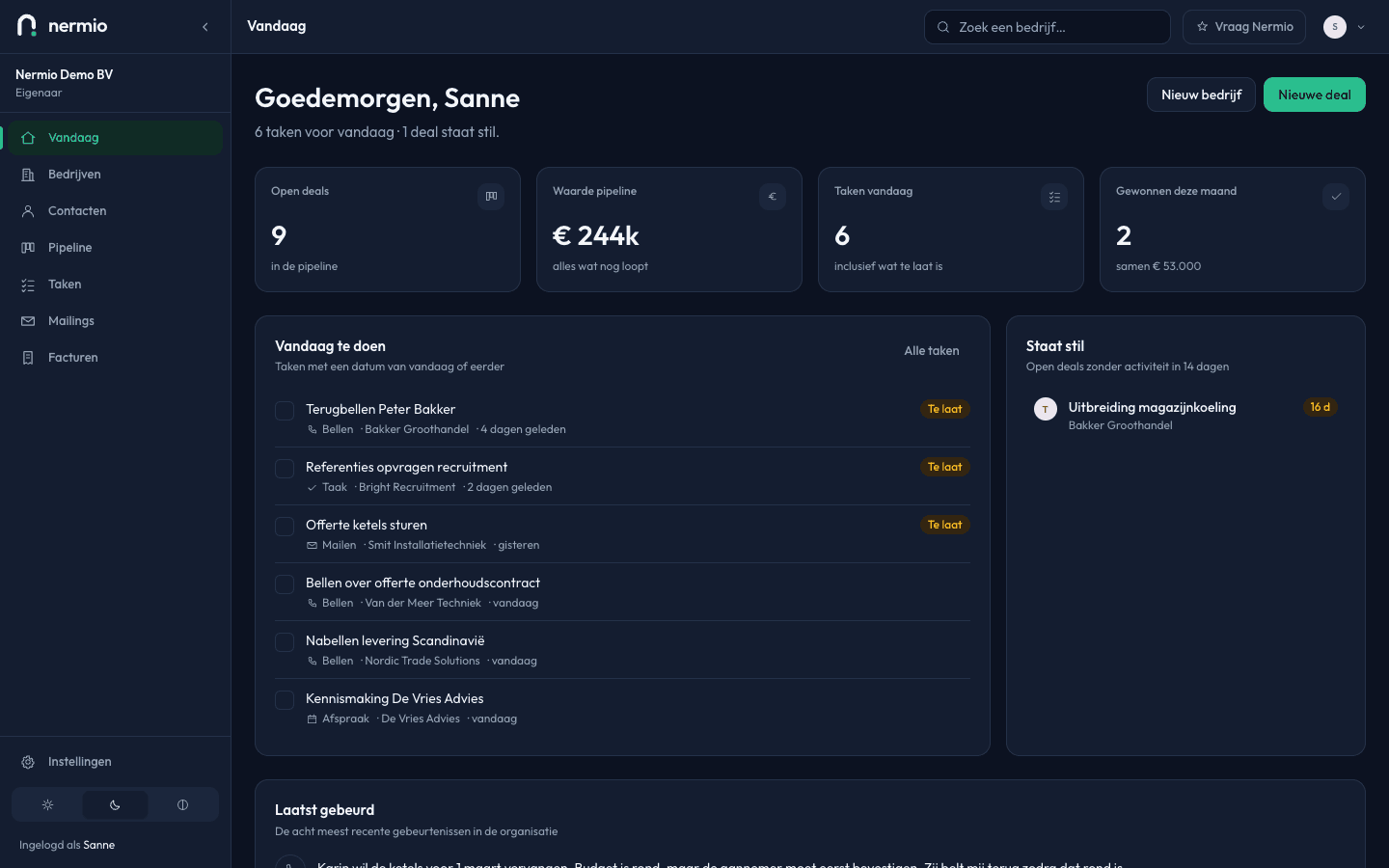
How it goes now
Not because you're careless, but because you work alone.
- You gave a price, the customer said "I'll let you know", and that was seven weeks ago. You can't remember whether you ever chased it.
- Someone said in March that it would be interesting "after the summer". It is November.
- A customer from two years ago rings, and you no longer know what you agreed or what you charged.
- Your arrangements sit in your inbox, your phone, a WhatsApp thread and on the back of an envelope.
- In a busy month you sell nothing, and that silence arrives two months later.
What you need instead
Not a system that describes your work. A system that remembers what you don't.
Working alone, it's tempting to think a spreadsheet is enough. It is, for the names. Where it stops is the date: a row in Excel doesn't speak up on the Tuesday you meant to ring, and you don't open it on the days you're on site.
The other thing you need is history. Not for completeness, but because your edge is that you still know what mattered to that customer last year. For one person that isn't an archive, it's your biggest asset, and right now it's in your head.
What Nermio does about it
Four things. All four work today.
You've given a price
Put it in the pipeline at the quote stage ("Offerte") and attach a task: ring in two weeks. The deal then surfaces on the date you chose, not on the day you happen to think of it.
It's been quiet for six weeks
The Today screen shows which deals have sat still too long. That's the list you can't draw up yourself in a busy month, and the reason the silence doesn't go unnoticed for a quarter.
An old customer rings
You look up the company and see the whole timeline: the notes from the time, what happened, and which stage it ended in. Three lines you typed back then in a minute.
You lose a job
When you mark a deal lost, Nermio asks why. After twenty of them you no longer have a feeling but a breakdown: too expensive, too late, or someone else got there first. That's the only honest view of your pricing you can get.
About the price, honestly
Nermio costs €20 a month for your whole company paying yearly, €24 a month paying monthly. That "per company" is our main promise, and on your own it gets you nothing today: with one user, per company and per user are the same number.
It does mean something later. Take someone on next year, or work regularly with another sole trader, and that second account costs nothing extra. You don't have to choose again, and you don't have to keep conversations out of the system to keep the bill down.
What Nermio doesn't do here
There's no phone app. Nermio runs in a browser, and you keep it up to date at the end of the day in three lines, not between two jobs.
There's no time tracking. Invoicing is in there: with VAT, or without it under the Dutch small-business scheme (the kleineondernemersregeling, which lets you opt out of charging VAT below a turnover threshold), and as a PDF from your own email address. The VAT rules it knows are Dutch ones, not HMRC's. Your bookkeeping stays where it is — Nermio writes the invoice and exports it; the return is filed elsewhere.
You can't send campaigns to your customer list from it.
Further reading
Tasks and follow-ups
How an arrangement gets a date that speaks up, and how the Today screen opens your day.
Companies and contacts
The file and the timeline: where "what did they say last time?" is kept.
Following up with customers
When to chase, how often, and why the second time is the one that counts.
Start with the five you need to speak to this month
That's enough to find out whether you keep opening it. No credit card, and you're not tied to anything.