Not what was agreed, but who knows it
As soon as two people talk to customers, the knowledge sits in two places. That works until someone is away for a week, a customer says something you didn't expect, or a new colleague starts. Nermio makes one file of it, and your team pays once.
How it goes now
Each of these five costs you a customer a year, and you never notice.
- Two of you ring the same customer in the same week without knowing. The customer notices.
- On Monday the question is "did you ever chase that quote?" and nobody is sure.
- Someone is away for two weeks and their open conversations stand still. Not because nobody wanted to pick them up, but because nobody knew which ones were running.
- A new colleague has to learn three years of customer history out of someone's head, during breaks.
- There are two versions of the truth: the owner's spreadsheet, and the inbox of whoever had the conversation.
What makes a small team different
You don't have a coordination problem that a meeting solves.
In a sales department, handover exists as a process: someone divides the work, and there's a weekly meeting where everything comes up. With four people there is none of that, and you wouldn't want it — half an hour a week spent on ten open quotes costs more than the quotes.
What you do want is for the record to be made while the conversation is fresh, by the person who had it, in thirty seconds. So the barrier isn't the features but how much effort one note takes. And that is why everyone needs an account, including the colleague who only speaks to a customer now and then.
What Nermio does about it
Five things, all built around the same question: who else knows this besides you?
Everyone gets in, the people on the road included
You pay €20 a month for the company, not per person. So there's no weighing up who gets an account — which is where a per-user price falls over, because the conversations of the colleague without one are nowhere.
One timeline per company
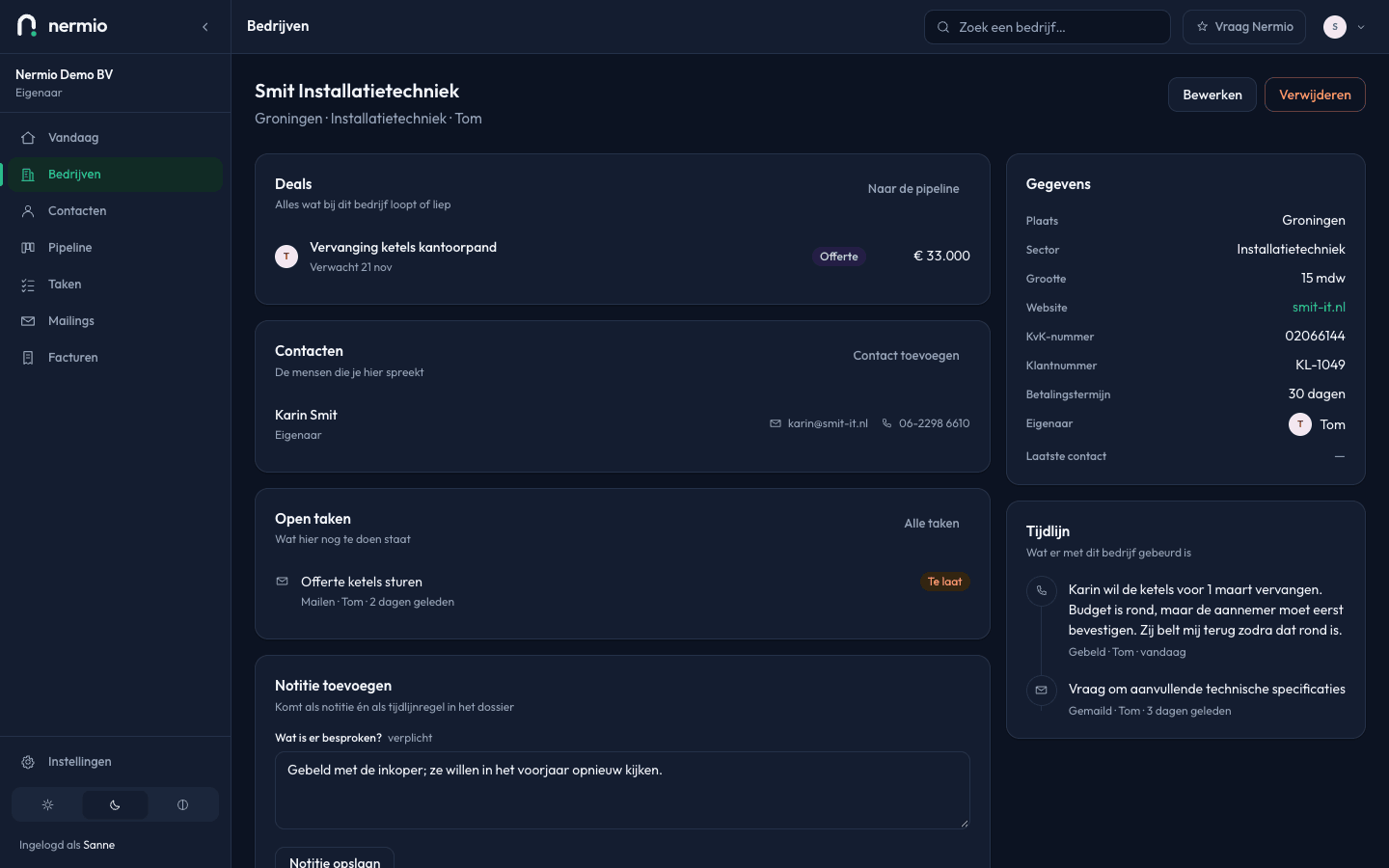
Every call, every note and every stage change sits with the company, with the name of whoever did it. You can see what your colleague discussed last week without asking.
Four roles
From full access to read-only. An intern or an admin colleague can read along without moving a deal by accident.
Deals standing still, anyone's
The Today screen shows the deals nobody has touched for too long. That's what you miss when someone is off sick: not that nothing is happening, but that you don't know what isn't happening.
An audit log nobody maintains
Who changed what, and when, is recorded and can't be rewritten. This isn't about distrusting your team; it's so that when a customer disagrees with you, you can look up what actually happened.
Getting it going with four people
The software isn't the problem; the agreement is.
One agreement is enough to make it work: after a customer conversation, three lines in the file and, if there's a next step, a task with a date. Not a required field, not a weekly check — one agreement everyone can repeat back.
Start with what's running rather than with your whole customer list. Ten to twenty open enquiries in the pipeline, and leave the rest where it is. You can import your companies and contacts as a CSV under Settings, but moving a full list across is work you won't see the value of.
What Nermio doesn't do here
There's no shared calendar and no link to your calendar software. Tasks have a date, but that date lives in Nermio and not in your diary.
There are no reports and no charts per person. If you want to settle up monthly on numbers per head, this isn't your software.
You can't send campaigns to a selection from your list.
Invite your team and see what's in it after a week
That's the test: not whether it can, but whether everyone does it. No credit card, and you're not tied to anything.