Getting started with a CRM
What is a CRM system?
What the term means, what sits inside one of these systems, when a spreadsheet is still enough, and when it isn't.
About 6 minutes to read
What the term means
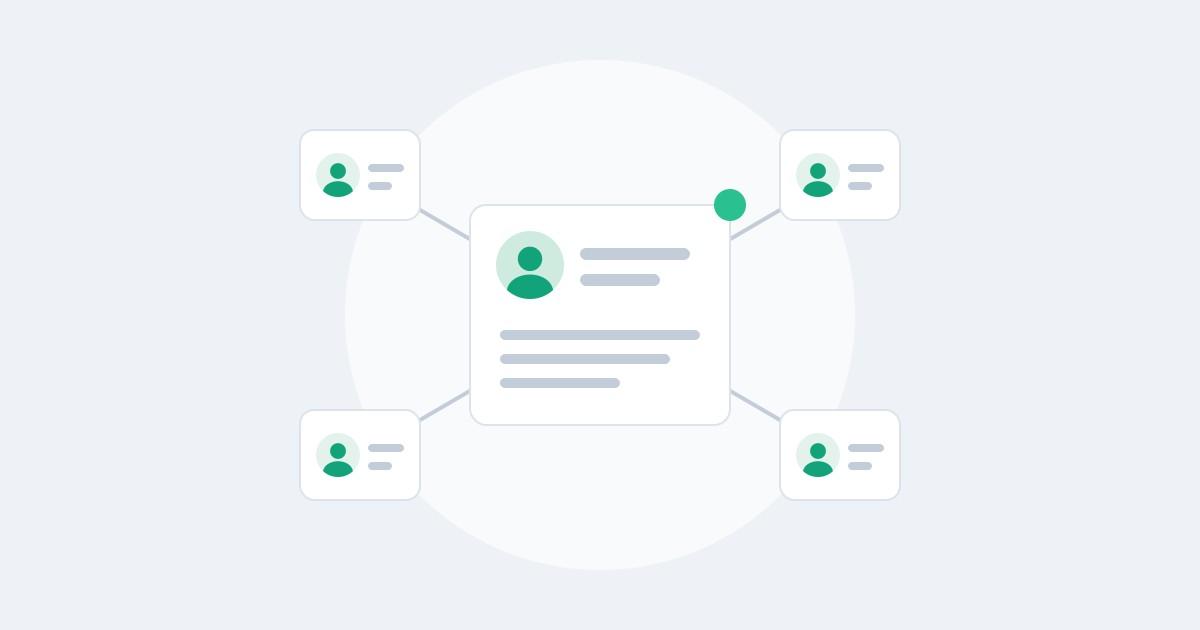
CRM stands for customer relationship management. That sounds bigger than it is. In practice a CRM system is one place that holds who you deal with, what was agreed, and what happens next. Nothing more, and for most businesses nothing less.
You already hold that information. It sits in your inbox, on your phone, in a notebook next to your keyboard, and in the head of whoever had the conversation. A CRM invents none of it. It puts it in one place and makes it findable by someone other than you.
What's in one
Almost every CRM, cheap or expensive, works with the same five kinds of record:
- Companies. The organisation you deal with: address, trade, and the reason it's on your list at all.
- Contacts. The people at that company. Who decides, who watches, and who actually answers the phone.
- Deals. What you hope to sell, for how much, and how far along it is.
- Tasks. What you promised to do, and by when.
- History. What was said, by whom, and on what date.
Where you notice the difference
The difference isn't the software. It's what the software lets you do. Three things get easier once the information is written down somewhere.
You forget less. A promise with a date attached comes back on the day it's due. A promise in your head comes back when the customer rings to ask what happened to it.
Your colleague knows too. If you're off for a week, someone else can pick up the conversation without the customer having to start again. That's the difference between a business and a group of people who happen to share an office.
You can see where things stall. Not in charts, but in something plainer: which deals haven't moved in three weeks, and which customers you haven't spoken to in six months.
When a spreadsheet is still enough
This is the part most CRM suppliers leave out. A spreadsheet is a perfectly good CRM as long as three things hold: you're the only person maintaining it, you have fewer than about fifty relationships, and nothing you sell takes longer than one conversation.
That isn't a rare position to be in. Of the 5.7 million private sector businesses in the UK at the start of 2025, 4.3 million had no employees beyond the owners. If you're one of them, a CRM may well be a fix for a problem you don't have yet.
It stops holding the moment a second person is involved. Two people in one file means two versions, and the correct one is always the one you don't have open. It also stops holding the moment a sale takes several steps: a spreadsheet keeps no order of events and reminds you of nothing. There is a longer piece on where exactly that line sits.
Why most CRMs stop being kept up to date
Ask around and you'll hear the same sentence often enough: we've got one, but nobody uses it. That's rarely about the people.
It's about the work in between. If logging a call takes five clicks and three mandatory fields, you won't do it at the end of a busy day. Skip a week and the contents stop being true — and at that point the whole thing is worse than nothing, because a CRM that's half full is something you trust and shouldn't.
The SME Digital Adoption Taskforce, reporting to the Department for Business and Trade, found much the same when it asked why smaller firms don't take up software: adoption often looks too hard and too costly, and switching from one tool to another feels like too much risk. Those are reasonable objections, not a failure of nerve.
So the question worth asking isn't *what can this system do*. It's will I still be doing this at a quarter past four on a Tuesday afternoon.
What to do with that
If you're working alone with a short list, keep the spreadsheet and put the next step in your calendar. If you're two or more people, or you sell in several steps, the cost of not writing things down is already being paid — usually in follow-ups nobody made.
Either way, judge a system on the half-hour it takes to log a week of work, not on the length of its feature list. If price is the question you're stuck on, what a CRM actually costs breaks down where the money goes.
Sources
- Business population estimates for the UK and regions 2025 — Department for Business and Trade, GOV.UK
- SME Digital Adoption Taskforce: final report — Department for Business and Trade, GOV.UK